Most traders obsess over where to enter. Far fewer think about the question that actually decides whether they survive a bad run: how much to put on the line in the first place. Crypto position sizing is that decision — and it’s the quiet reason two traders with identical calls can end a rough month one bruised and one wiped out. It’s the first thing we’d teach, and it flows directly from crypto risk management as a whole.
What position sizing actually is
Position sizing is deciding how large a position to take, based on how much you’re willing to lose if the trade goes wrong — not on how confident you feel or how much you’d like to make. Confidence sizes the account to zero eventually; a fixed, small risk per trade keeps you alive through the losing streaks that every approach produces. The mindset shift is this: you don’t size a position by the upside you’re dreaming of, you size it by the downside you’ve accepted.
The core idea: risk a small, fixed fraction
The most widely used rule is simple: risk no more than 1% of your account on any single trade. Some traders use 0.5%, some go to 2%, but the principle is the same — keep the per-trade risk small enough that a string of losses is survivable. At 1% risk, it takes a genuinely rare run of losers to do serious damage, which means you get to keep trading your process instead of scrambling to recover.
“Risk 1%” means the distance from your entry to your exit costs you 1% if it’s hit — so the size of the position depends on where the stop-loss goes. A tight stop lets you take a larger position for the same 1%; a wide stop means a smaller one. The risk stays fixed; the size flexes to fit it.
How to calculate it
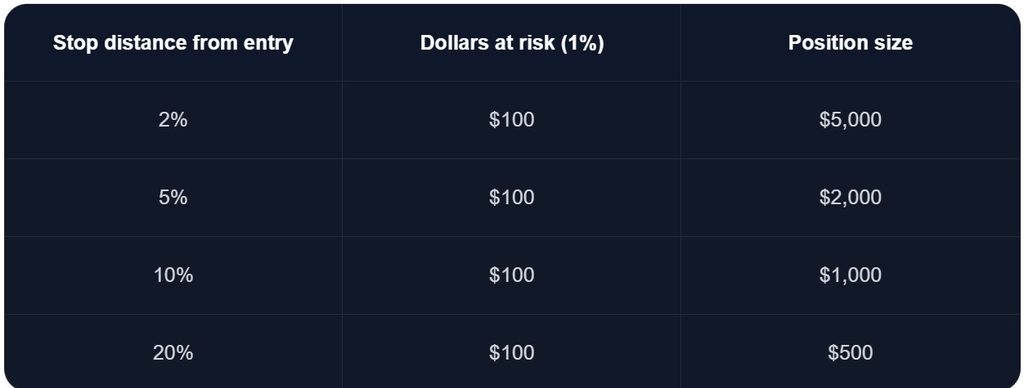
The formula is short: Position size = (Account × Risk %) ÷ (distance from entry to stop, as a %). Suppose a $10,000 account risking 1% — that’s $100 at risk on the trade. If your stop is 5% away from your entry, your position is $100 ÷ 0.05 = $2,000. If the stop is only 2% away, the same $100 of risk supports a $5,000 position. Same risk, different size, decided by the stop distance — not by how much you want to buy.
Here’s how a fixed 1% risk on a $10,000 account translates at different stop distances:
Why the stop has to come first
You can’t size a position until you know where you’re wrong. That’s why sizing is the step after you’ve marked your invalidation level, not before. Traders who reverse this — picking a position size first, then placing a stop wherever keeps the loss “comfortable” — end up with stops jammed into the noise, and get shaken out of good trades. Idea first, invalidation second, size last. Money is always the final variable.
Leverage doesn’t change the math
A common trap is thinking leverage changes how much you should risk. It doesn’t. Whether you use leverage or not, your rule is still “risk 1% of the account,” and the stop distance still sets the size. Leverage only changes how much margin the position requires — not how much you’re willing to lose. If anything, leverage makes disciplined sizing more important, because it makes it easier to accidentally put far more at risk than you intended.
Common mistakes
Sizing by conviction. “I’m really sure about this one” is exactly when oversized positions get taken — and certainty is not a risk parameter.
Fixed dollar or fixed unit sizes. Buying “$1,000 worth” every time ignores stop distance entirely, so your real risk swings wildly from trade to trade.
Revenge sizing. Doubling up to win back a loss is how a bad day becomes a blown account. The rule doesn’t bend because you’re behind.
Ignoring whether it’s even worth it. Sizing tells you how much to risk; it doesn’t tell you if the trade is good. That’s whether the reward justifies it — a separate question worth answering before you commit.
How Pineva fits
In the futures workspace, size sits right next to the scenario and its invalidation, so the question “how much should this be?” is answered from the stop distance rather than from a gut feeling. Pineva won’t tell you how confident to be or promise the trade works — it keeps the sizing honest and tied to the risk you actually defined.
You can start free and size your first position properly in a couple of minutes.
The takeaway
Position sizing isn’t the exciting part of trading, but it’s the part that decides whether you get to keep trading at all. Risk a small, fixed fraction of your account; let the stop distance set the size, not your mood; and never let a position grow because you feel sure or because you’re trying to get even. Protect the account first, and every good decision after it gets the chance to matter.
For research and education. Not financial advice. Crypto trading involves risk.