
Trading discipline is the least technical skill in trading and, for most people, the hardest. You can learn to read structure, size a position and calculate a risk-to-reward ratio in an afternoon. Doing all of it correctly when real money is on the line, and your gut is screaming the opposite, is the work of years. It’s the final piece of crypto risk management — and without it, every other skill quietly falls apart.
What trading discipline actually is
Discipline is doing what your prepared self decided, even when your in-the-moment self objects. Notice there are two versions of you. The calm one, planning before the market opens, makes good decisions: reasonable stops, sensible sizes, patient entries. The live one, watching price tick against a position, is flooded with fear and hope and wants to tear the plan up. Discipline is simply letting the calm version win. That’s it — and that’s why it’s so hard.
Why it’s the skill that makes the others work
Every other risk skill assumes you’ll follow through. A stop-loss only protects you if you leave it where you put it. A position size only limits your loss if you don’t add to a loser. A great risk-to-reward ratio only pays off if you hold the trade to its target instead of bailing early. Skills give you a good plan; discipline is what turns a plan into a result. Without it, you don’t have a strategy — you have a list of good intentions you abandon under pressure.
Discipline vs. emotion, in practice
Discipline isn’t abstract; it shows up in specific moments where the disciplined move and the emotional move point in opposite directions:
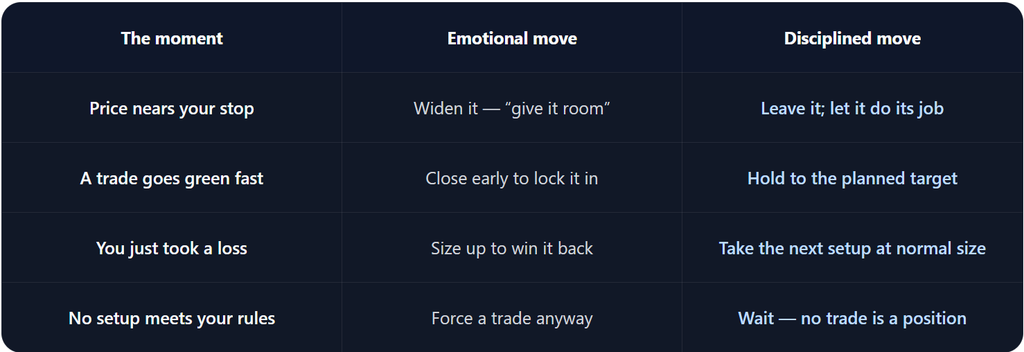
In every row, the emotional move feels right in the moment and is wrong over time. Two of them — moving a stop-loss toward hope and closing winners too early — quietly do most of the damage to otherwise good traders.
How to actually build it
Discipline isn’t willpower you’re born with; it’s built with structure that removes decisions from the heat of the moment.
Decide everything in advance. Entry, stop, size and target all chosen before you enter means there’s nothing left to negotiate while emotions run high.
Write it down. A plan in your head bends to fit your feelings. A plan on the screen is harder to argue with.
Keep a journal. Reviewing where you broke your own rules — and what it cost — is how the pattern becomes impossible to ignore.
Think in scenarios. When you already hold scenarios instead of predictions, a move against you is something you planned for, not a shock — which is exactly when discipline is easiest to keep.
Common mistakes
Blaming the strategy. Most “the system doesn’t work” really means “I didn’t follow the system.” Fix the following before you change the plan.
Relying on willpower. White-knuckling it fails under stress. Structure beats willpower every time.
Revenge trading. Trying to win back a loss immediately is emotion in its purest form, and it’s account-ending.
All-or-nothing thinking. One broken rule isn’t a reason to abandon the day. Note it, reset, and take the next trade properly.
How Pineva fits
Discipline is easiest when the plan is already built and sitting in front of you. In the futures workspace, the scenario, invalidation, size and target are defined before the trade is live, so the pressured version of you has less room to improvise. Pineva can’t make you follow the plan — nothing can — but it makes the plan concrete and visible, which is most of the battle.
You can start free and let the structure carry some of the discipline for you.
The takeaway
Trading discipline is just letting your calm, prepared self overrule your anxious, live self — over and over, trade after trade. It’s not glamorous and it’s never finished, but it’s the multiplier on everything else: the stop, the size, the ratio, the scenario all only work if you actually follow them. Decide in advance, write it down, review honestly, and let structure do what willpower can’t. That’s the whole game, and it’s the part that’s entirely yours.
For research and education. Not financial advice. Crypto trading involves risk.