Knowing you should research a project is easy; knowing exactly what to look at is the hard part. This is the step-by-step version — a checklist you can run on any coin before you buy, in roughly the order that saves you the most time. It’s the practical companion to crypto fundamental analysis, which covers why each of these matters; here we just do the work.
Step 1: Understand what it actually does
Before anything else, answer one question in a single sentence: what problem does this project solve, and why does it need a blockchain to solve it? If you can’t explain it plainly after reading the homepage and a paragraph of the docs, that’s information in itself. Plenty of projects dress up “a database, but with a token” in complicated language. A real project has a purpose you can state simply and a reason to be decentralized at all.
Step 2: Check the team
Find out who is building it. Are they public and verifiable, with track records you can look up, or anonymous handles? Anonymity isn’t automatically disqualifying — some legitimate projects have pseudonymous founders — but it raises the bar for everything else. Look for whether the team actually ships: real updates, a code repository with genuine activity, roadmaps that turned into products rather than promises. A team that delivers beats a team that markets, every time.
Step 3: Look at the token economics
A good product can still be a bad token. How large is the supply, and how much of it is actually circulating versus locked and waiting to be released? Who holds it — is a huge share concentrated with insiders and early investors whose unlocks could flood the market? This is deep enough to deserve its own guide, so when a project passes the earlier steps, dig into the token economics properly before going further.
Step 4: Look for real adoption
Separate real usage from noise. Social media buzz and a rising price are not adoption. Look for signs that people actually use the thing: active addresses, real transaction volume, integrations that exist, developers building on top of it. A quiet project with genuine usage is far more interesting than a loud one with nothing but a community hyping the price to each other.
Step 5: Hunt for red flags
Now flip your mindset and actively try to reject the project. This is the step most people skip, and it’s the most valuable one. Good due diligence spends real effort looking for reasons to walk away, because the cost of missing a red flag is far higher than the cost of skipping a decent opportunity. Here’s the quick reference to keep beside you:
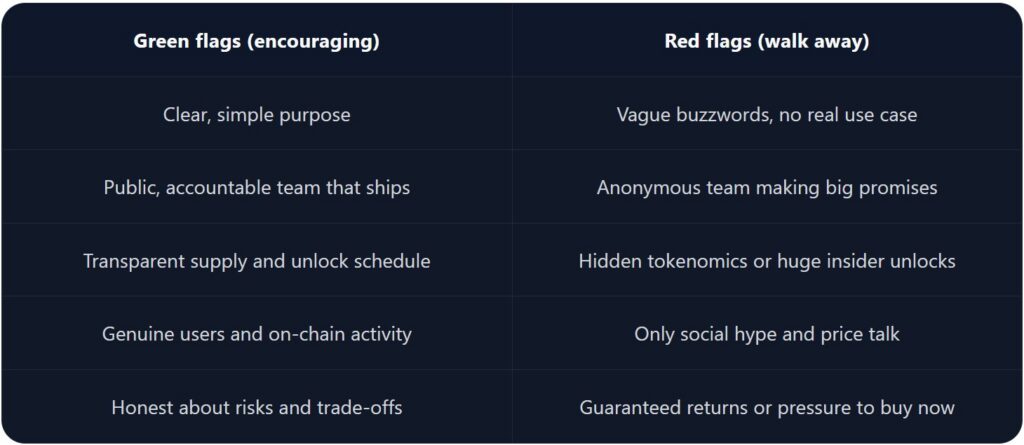
One serious red flag outweighs several green ones. When you find a real reason to walk away, the search is over — that’s the checklist working, not failing.
Step 6: Decide, size, and track
If a project clears every step, you’ve earned a decision — but research only tells you whether to own it, not how much. Keep the two separate: decide how much to risk on it as its own step, and for the projects that pass but aren’t a buy today, keep it on a watchlist instead of forcing an entry. A strong project at the wrong time is a note for later, not a trade for now.
A note on where the research goes
The hardest part of a checklist isn’t the steps — it’s keeping the findings organized so they inform an actual decision. The the spot research workspace is built to hold this in one place: your notes, the context and the watchlist together, so the research adds up to a judgment instead of scattering across browser tabs you’ll never reopen.
Common mistakes
Researching to confirm, not to decide. If you’ve already bought in your head, you’ll find reasons to justify it. Research before conviction, not after.
Skipping the red-flag step. Only looking for reasons to buy is how people walk into obvious traps.
Confusing price action with fundamentals. A number going up is not evidence the project is good; it’s just a number going up.
Outsourcing the whole thing. Someone else’s conviction can’t be held through a drawdown. The research has to be yours.
The takeaway
Run the same steps every time: understand what it does, check the team, examine the tokenomics, look for real adoption, and then deliberately hunt for red flags. Let one serious red flag end the search, keep the survivors on a watchlist, and decide size as a separate question. A checklist won’t make every pick a winner — nothing will — but it turns buying crypto from a hope into a decision, which is the entire point.
For research and education. Not financial advice. Crypto trading involves risk.