You can find a project with a brilliant product, a strong team and real users — and still lose money holding its token. The reason is almost always tokenomics: the design of the token itself. Tokenomics explained simply is the study of how a token is supplied, distributed and used, and whether those mechanics work for holders or against them. It’s one dimension of the wider research checklist, but it’s important enough to understand on its own.
What tokenomics means
Tokenomics is a blend of “token” and “economics” — the rules that govern a token’s supply and demand. A great business with a token that constantly inflates, or that dumps huge amounts onto the market as insiders unlock, can still be a terrible investment. Tokenomics is how you check whether owning the token actually lets you share in the project’s success, or whether you’re just providing exit liquidity for people who got in earlier and cheaper.
The supply side
Start with supply, because it’s where most traps live. Three numbers matter. Circulating supply is how many tokens exist and trade right now. Total supply is how many exist including locked ones. Max supply is the ceiling, if there is one. The gap between circulating and max is the warning zone: if only 10% of tokens are circulating and the rest will unlock over the next two years, a lot of new supply is coming that can push the price down regardless of how well the project does. A low price next to a high “fully diluted valuation” is a classic thing to miss.
Distribution: who holds it
Next, who owns the supply. A healthy distribution is reasonably spread across the community, team, investors and a treasury. A dangerous one concentrates most tokens with insiders and early investors, whose unlock schedule then hangs over the market like a weight. Ask two questions: what percentage went to insiders versus the public, and when do their tokens unlock? Big cliffs — dates where a large tranche suddenly becomes sellable — are events worth knowing about before you buy, not after.
Emissions and inflation
Some tokens continuously create new supply to pay stakers, farmers or validators. That isn’t automatically bad, but you have to ask whether real demand is growing faster than new supply is being printed. If a token pays a juicy yield but emits so heavily that its price bleeds, the yield is an illusion — you’re being paid in a currency that’s inflating away underneath you. Sustainable emissions are backed by real usage; unsustainable ones are just money printing with extra steps.
Utility: why hold it at all
Finally, demand. What actually makes someone want to hold this token rather than sell it? Real utility means the token is needed to use the product, earn a genuine share of fees, secure the network, or govern something that matters. Weak utility means the only reason to hold is the hope someone pays more later — which is another way of describing a game of musical chairs. A token needs a reason to exist beyond “the project needed a token.”
A quick reference
Here’s the whole framework in one place — what to look at, what it tells you, and the warning sign for each:
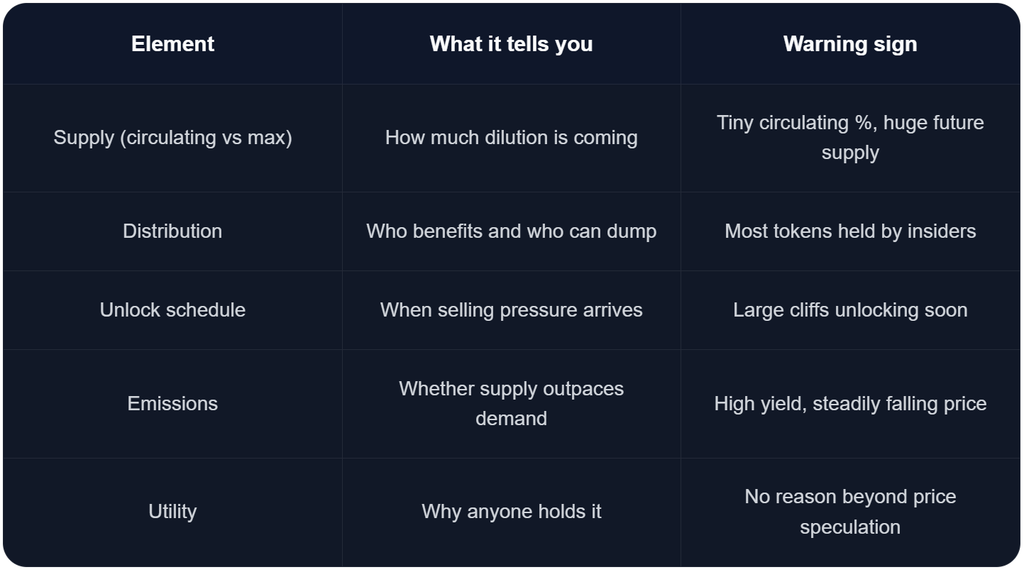
No single row decides it, but a project that fails several — tiny float, insider-heavy, unlocking soon, no real utility — is telling you exactly what it is.
How to actually use this
You don’t need to build a spreadsheet. Pull up the token’s supply and distribution, glance at the unlock schedule, and ask the five questions above. If the tokenomics are healthy, the project moves forward in your research; if they’re clearly predatory, you’re done — no product is good enough to overcome a token designed to transfer wealth away from holders. For the projects that pass, keep it on a watchlist so you can act on timing rather than impulse.
Common mistakes
Judging price without supply. A “cheap” token with an enormous hidden supply isn’t cheap; it’s expensive in disguise.
Ignoring unlocks. Buying right before a major insider unlock is buying into built-in selling pressure.
Chasing yield blindly. A high APY funded by heavy emissions often loses you more in price than it pays in tokens.
Assuming a good product means a good token. They’re separate questions. Both have to pass.
How Pineva fits
Tokenomics is context, and context is what the spot research workspace is built to gather — the supply, distribution and usage picture in one place, alongside the rest of your research on a project. Pineva won’t grade a token for you or tell you it’ll go up; it keeps the details that decide a token’s fate visible, so a pretty chart can’t distract you from an ugly unlock schedule.
You can start free and check a token’s fundamentals before its price convinces you.
The takeaway
A token is not the same thing as the project behind it. Check the supply and how much dilution is coming, see who holds it and when they can sell, ask whether emissions outpace demand, and demand a real reason to hold at all. Healthy tokenomics won’t guarantee a winner, but predatory tokenomics almost guarantees a loser — and spotting the difference is one of the highest-value habits a spot investor can build.
For research and education. Not financial advice. Crypto trading involves risk.