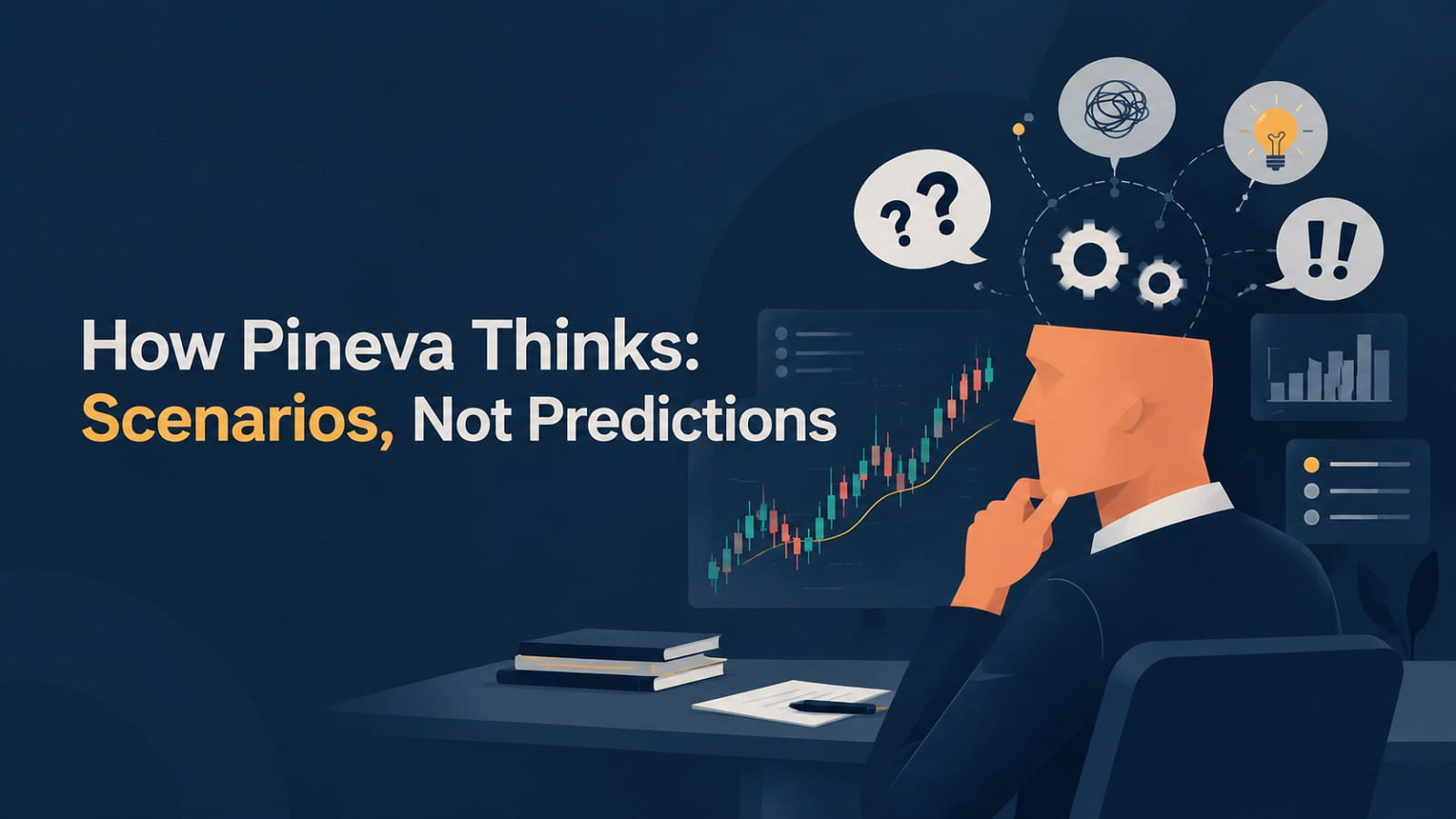
At Pineva, we believe better crypto decisions start with research, clear scenarios, and disciplined risk management, not price predictions. Our approach helps traders understand market conditions, evaluate potential outcomes, and define their risk before taking action. Discover the thinking behind Pineva and how our decision-making framework brings structure and clarity to crypto trading.
Crypto trading does not come with certainty, and we built Pineva around that reality. Pineva is a crypto research and decision-support workspace designed to help traders understand the market, evaluate different scenarios and define their risk before making a decision. We do not sell signals or promise returns. Our approach is built on two principles: research before risk and scenarios instead of predictions.
Inside the Pineva Workspace
We designed Pineva around a simple idea: a trading decision should make sense before money is committed, not just after the market moves in the right direction.
In the Pineva workspace, trading ideas are presented through primary and alternative scenarios, with clear triggers, invalidation conditions and risk information alongside them. Instead of receiving a single price prediction, traders can examine the reasoning behind an idea and the conditions that would support or invalidate it.
The research side of our methodology focuses on understanding crypto assets before taking a position. The trading side focuses on market structure, conditional scenarios and planned exposure.
These elements serve different purposes, but they belong in the same decision-making process.
| What Pineva focuses on | What it means for the trader |
| Market research | Understand the asset and the evidence behind an idea |
| Market structure | Identify trends, ranges and meaningful price levels |
| Primary scenario | Define the conditions supporting the main market outlook |
| Alternative scenario | Prepare for a different market development |
| Invalidation | Establish when the original idea no longer holds |
| Risk planning | Decide position size and exit conditions before acting |
| Final decision | Act, wait or pass based on the available conditions |
Pineva provides the structure for evaluating these elements. The decision to place a trade remains with the user.
Research Before Risk
We believe the quality of a trading decision starts with understanding what is being traded.
A rising price alone does not explain whether a crypto asset deserves attention. For spot investments, our research approach looks beyond the chart and examines the project itself, the people developing it, its tokenomics and evidence of real adoption.
The purpose is to understand what supports the asset’s value and which factors could weaken the investment case.
This distinction matters because finding an interesting project and finding a suitable entry are not the same decision. A project can have convincing fundamentals while its current market conditions fail to justify taking a position.
At Pineva, we separate those judgments. Research establishes the context for considering an asset. Market analysis determines the conditions under which a trading idea becomes actionable.
Market Structure Before Market Direction
Before evaluating a potential trade, we begin with reading market structure.
We want to understand whether the market is trending or moving within a range, which price levels matter and what changes would challenge the current interpretation.
A price movement has little meaning without that context. A breakout, for example, needs to be assessed in relation to the structure it is breaking.
This is also where our preference for conditional thinking becomes important.
The distinction behind Trading Scenarios vs. Predictions is straightforward. A prediction gives one expected outcome. A scenario defines the conditions under which a particular outcome becomes relevant.
In Pineva, the primary scenario describes the main path supported by the current analysis. The alternative scenario prepares for a different development if market conditions change.
Each scenario needs an identifiable trigger. Until that condition is met, the scenario remains a possibility rather than a reason to act.
This is the foundation of our approach to crypto market analysis. We do not need to claim knowledge of the next price movement to prepare a structured response to it.
Invalidation Before Entry
A trading idea is incomplete until we know what would make it wrong.
That is why we define an invalidation level before treating a scenario as actionable.
Invalidation identifies the price or market condition that contradicts the reasoning behind an idea. It should follow the market structure rather than an arbitrary percentage of loss.
For example, if a bullish scenario depends on a particular support level holding, a decisive breakdown of that level can invalidate the original reasoning.
This is different from simply deciding how much money we are prepared to lose. The market determines whether the thesis still makes sense; the risk plan determines how much exposure we accept if it fails.
We keep those two decisions connected.
A clearly defined invalidation also makes it easier to recognize when an idea needs to be abandoned rather than defended.
Our Repeatable Trade Planning Process
We do not believe every market movement requires a new trading method. What matters is applying a consistent process to the information available.
Our trade setup framework brings the essential decisions into one sequence:
- Examine the market context and underlying structure.
- Define the primary scenario.
- Prepare an alternative scenario.
- Establish the trigger and invalidation conditions.
- Determine the acceptable risk, position size and exit.
- Decide whether to act, wait or pass.
The order matters. Choosing a position size before understanding the invalidation creates a different decision from choosing the size based on a defined risk boundary.
This process also gives waiting a clear role.
When the required conditions are absent, there is no reason to force an entry. When the potential reward does not justify the defined risk, passing on the trade is consistent with the plan.
We want the quality of a decision to depend on its reasoning, not on the pressure to participate in every market movement.
The Pineva Method in Practice
Consider a cryptocurrency trading within a clearly defined price range.
A prediction-based approach would announce that the asset is about to break out and move higher. Our approach begins by identifying what would make that bullish outlook worth considering.
The primary scenario could require price to break above the range and hold that level. A failed breakout would challenge the bullish interpretation, while a breakdown below the range could support an alternative bearish scenario.
Before acting, we would also establish the level that invalidates the intended trade, the acceptable loss and the position size that respects that limit.
The result is a decision with defined conditions rather than a commitment to one expected outcome.
If the market remains inside the range without confirming either path, the plan does not require a trade.
This example captures the purpose of Pineva’s methodology: giving every market idea a reason, a condition and a boundary.
The Difference Between Pineva and Trading Signals
A trading signal directs attention toward an action, such as buying or selling an asset at a particular price.
Our approach puts the reasoning before the action.
We want traders to understand the conditions behind a scenario, the evidence supporting it and the circumstances under which it stops making sense.
Pineva does not place orders on behalf of users or manage their trades. It also does not guarantee that a scenario will succeed.
That distinction is important to us. Even a well-researched idea with a clearly defined setup can result in a loss. A profitable trade, on the other hand, does not automatically prove that the original decision was sound.
We focus on the parts of the process that traders can control: preparation, exposure, exit conditions and adherence to a plan.
Our role is to make those decisions easier to examine before the market creates pressure to act.
The Traders Pineva Is Built For
Pineva is designed around a decision-making approach that values preparation over certainty.
It is relevant to traders who want to examine more than one market outcome, understand why a setup exists and define their exposure before entering a position.
The same thinking applies to spot research, where understanding the asset comes first, and to scenario-based trade planning, where the conditions for action must be clear.
Pineva is not intended to replace a trader’s judgment. It provides a structured way to apply that judgment.
We believe the most useful trading tool is one that helps you understand not only the reasons for taking a position, but also the reasons for rejecting it.
The Thinking Behind Pineva
We built Pineva around a belief that traders deserve more than confident predictions. They deserve a clear view of the information behind a decision, the possibilities ahead and the risks involved.
Research helps us understand what deserves attention. Scenarios define the conditions for action. Invalidation identifies when an idea stops working. Risk planning determines the exposure we are prepared to accept.
Pineva brings that thinking into a structured decision-making workspace while leaving the final choice with the trader.
We cannot remove uncertainty from crypto markets. We can approach that uncertainty with a clear plan.
That is how Pineva thinks.
Pineva provides research and decision-support tools, not financial advice. Cryptocurrency trading involves risk, and losses remain possible even with a structured plan.
For research and education. Not financial advice. Crypto trading involves risk.